Eyad
N.
Daher
eyaddaher.com

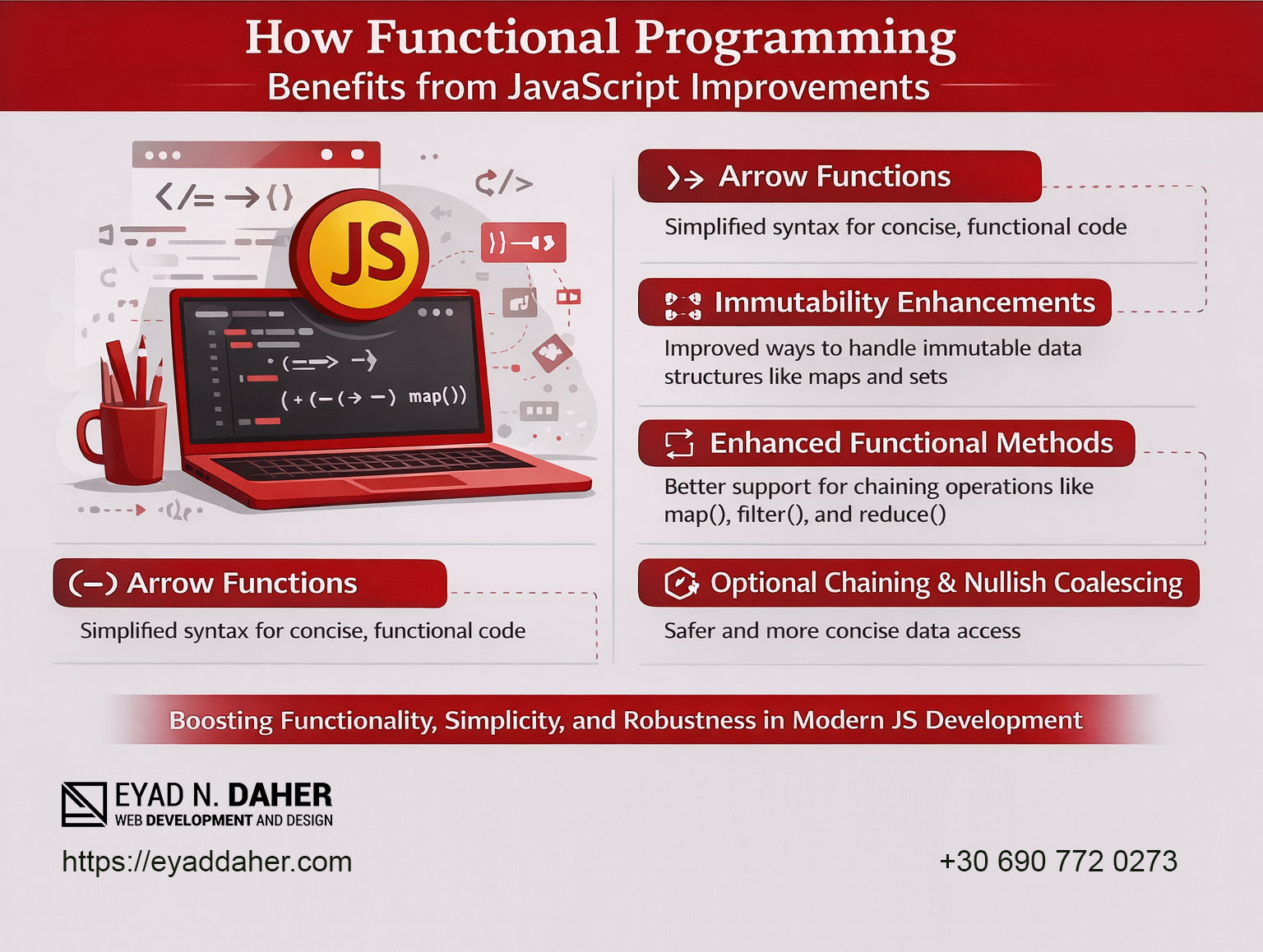
JavaScript has evolved dramatically over the last decade. What started as a lightweight scripting language has become a powerful, expressive, and mature ecosystem. One area that has benefited the most from this evolution is Functional Programming (FP). Modern JavaScript now provides the tools, syntax, and performance needed to write clean, predictable, and maintainable functional code.
What Is Functional Programming?
Functional Programming is a paradigm that emphasizes:
-
Pure functions (no side effects)
-
Immutability
-
Function composition
-
Declarative code over imperative logic
The goal is simple: write software that is easier to reason about, test, and scale.
Modern JavaScript Features That Empower Functional Programming
1. Arrow Functions & Cleaner Syntax
Arrow functions introduced a concise syntax that aligns perfectly with FP principles. They make functions easier to compose, pass around, and read.
Benefits:
-
Less boilerplate
-
Clear intention
-
Encourages small, reusable functions
2. Immutable Data Patterns
While JavaScript does not enforce immutability, modern features strongly support it:
-
constfor safer variable declarations -
Spread operators (
...) for cloning objects and arrays -
Array methods like
map,filter, andreduce
These tools make it easier to avoid unexpected mutations and write predictable logic.
3. First-Class & Higher-Order Functions
JavaScript treats functions as first-class citizens. Combined with improvements in performance and syntax, this enables powerful higher-order functions that are central to FP.
Examples include:
-
Passing functions as arguments
-
Returning functions from other functions
-
Composing behavior dynamically
4. Async/Await: Functional Control Flow for Async Code
Callbacks and promise chains were once a challenge for functional purity. The introduction of async/await allows developers to write asynchronous code that remains readable and easier to reason about.
Async functions:
-
Reduce side effects
-
Improve composability
-
Simplify error handling
5. Modern Tooling & FP Libraries
The JavaScript ecosystem has embraced FP with mature libraries such as:
-
Ramda
-
Lodash (FP variant)
-
Immer
Combined with TypeScript and ESLint rules, developers can now enforce functional patterns and catch side effects early in development.
Performance Improvements Make FP Practical
Earlier concerns about performance overhead have largely disappeared. Modern JavaScript engines (V8, SpiderMonkey) are highly optimized for functional patterns, making FP not only elegant but also production-ready.
Why Functional Programming Matters Today
As applications grow more complex and distributed, predictable code becomes essential. Functional Programming, supported by modern JavaScript improvements, helps developers:
-
Reduce bugs
-
Improve testability
-
Scale applications with confidence
JavaScript’s evolution has turned FP from a niche style into a practical, powerful approach for real-world applications.
Final Thoughts
Functional Programming is no longer a theoretical concept in JavaScript—it is a natural fit. Thanks to modern syntax, performance gains, and ecosystem support, JavaScript has become one of the most accessible languages for applying functional principles effectively.
For teams building scalable, maintainable, and future-proof applications, embracing Functional Programming in modern JavaScript is a strategic advantage.