Eyad
N.
Daher
eyaddaher.com

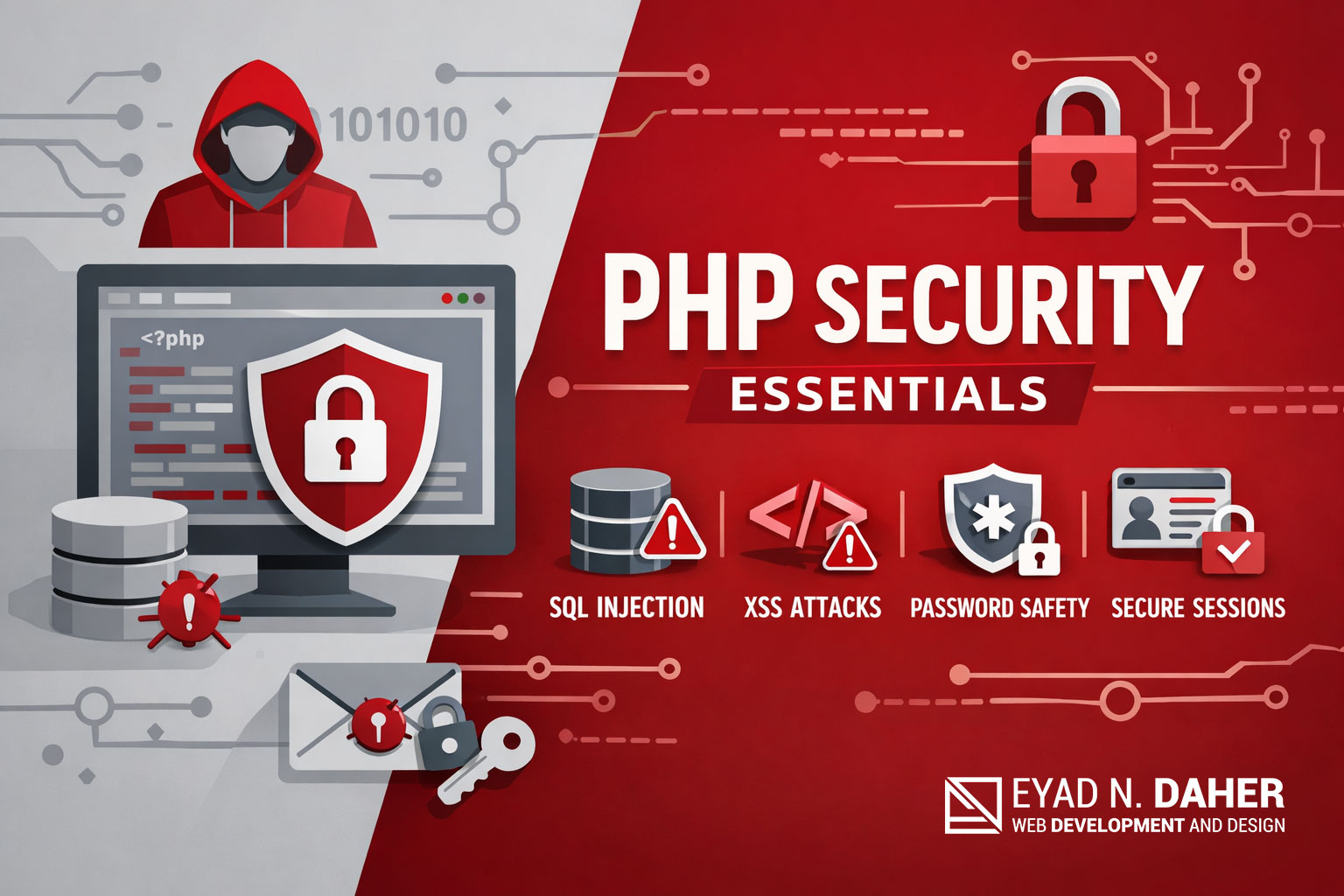
Security is one of the most critical aspects of modern web development. As a freelance PHP developer, delivering secure applications is not just a bonus — it’s a responsibility. From small business websites to large custom platforms, even a minor vulnerability can lead to data leaks, financial loss, and loss of trust.
In this post, we’ll explore essential PHP security practices every freelance developer should follow to protect web applications from common threats.
1- Secure Your Forms and User Input
User input is the #1 attack vector for most PHP applications.
Best practices:
- Always validate and sanitize input using filter_input() or filter_var()
- Never trust data from forms, URLs, cookies, or headers
- Apply server-side validation even if JavaScript validation exists
Tip: Treat *all input as malicious until proven safe.
2- Protect Against SQL Injection
SQL Injection remains one of the most dangerous and common attacks.
What you should do:
- Use prepared statements (PDO or MySQLi)
- Never concatenate raw user input into SQL queries
- Use least-privilege database users
Example mindset:
“If input touches the database, it must go through a prepared statement.”
3- Safely Handle Passwords
Storing passwords incorrectly can destroy an entire system’s security.
Always:
- Hash passwords using password_hash()
- Verify using password_verify()
- Never store plain text or weak hashes (MD5, SHA1)
Bonus:
- Use password strength rules
- Add rate limiting to login attempts
4- Prevent Cross-Site Scripting (XSS)
XSS attacks inject malicious JavaScript into your website.
How to reduce risk:
- Escape output using html-special-chars function
- Never display raw user content without filtering
- Be cautious with rich text editors and comments
Output escaping is just as important as input validation.
5- Secure Sessions and Authentication
Session hijacking can grant attackers full access.
Security tips:
- Use session regenerate id to true after login
- Set HttpOnly and Secure flags on cookies
- Enforce HTTPS everywhere
6- Keep Your PHP Environment Updated
Outdated software is an easy target.
Make sure you:
- Update PHP versions regularly
- Keep third-party libraries up-to-date
- Remove unused plugins, scripts, and old files
Final Thoughts
Security is not a one-time task — it’s an ongoing process. As a freelance PHP developer, prioritizing security not only protects your clients but also strengthens your professional reputation.
Investing time in secure coding practices today will save countless hours (and headaches) in the future.